
2026 Reading Plan Reflections - Day 180
No Small Errands
Acts 9:23–43
“In Joppa there was a disciple named Tabitha… Her life overflowed with good works and compassionate acts on behalf of those in need.” Acts 9:36 CEB
Acts 9 moves quickly between people and places. Saul escapes Damascus by being lowered through an opening in the city wall. He arrives in Jerusalem, where many believers are understandably afraid of him. Barnabas speaks on his behalf, and Saul begins proclaiming Jesus boldly. When another plot forms against his life, the believers send him away to Tarsus.
Then Luke turns our attention back to Peter. Peter travels to Lydda, where he encounters Aeneas, a man who has been unable to leave his bed for eight years. Peter tells him, “Aeneas, Jesus Christ heals you! Get up and make your bed” (Acts 9:34 CEB). Aeneas gets up, and many people turn to the Lord. From there, Peter is called to Joppa because a disciple named Tabitha has died.
In only a few paragraphs, we move from plots, escapes, public preaching, and the future apostle to the Gentiles into an upstairs room filled with grieving widows holding the clothes Tabitha had made for them. The scale of the story becomes smaller, but its importance does not.
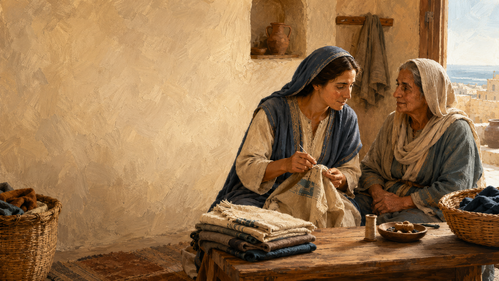
Tabitha is introduced as a disciple whose “life overflowed with good works and compassionate acts on behalf of those in need” (Acts 9:36 CEB). She had apparently become deeply connected to the widows of Joppa, women who often faced economic insecurity and social vulnerability. When Peter arrives, they surround him and show him the garments Tabitha had made while she was with them.
These clothes were more than evidence of her skill. They were evidence of her love.
Tabitha had allowed the grace of Christ to take visible form through the work of her hands. She noticed people who could easily be overlooked. She used what she had to care for them. Her ministry may not have attracted large crowds, but her absence left an entire community grieving.
There are no small errands in the kingdom of God.
Saul’s preaching mattered. Peter’s healing ministry mattered. Barnabas’s willingness to stand beside someone others feared mattered. The believers who lowered Saul through the wall mattered. The disciples who traveled to find Peter mattered. The widows and their grief mattered. Tabitha’s needle and thread mattered.
The church is not built only through people whose names appear on platforms, whose words fill books, or whose leadership is publicly recognized. Christ builds the church through women and men who receive grace, answer God’s call, and offer their lives in faithful love.
Tabitha should also keep us from treating the ministry of women as incidental to the church’s life and mission. Luke does not introduce her as a helpful woman hovering around the edges of the congregation. He calls her a disciple. Her ministry has formed a community, cared for the vulnerable, and made the compassion of Jesus visible.
The Church of the Nazarene has long affirmed that the Holy Spirit calls women and men to every level of Christian ministry, including the offices of pastor and elder. That conviction is not an accommodation to the spirit of the age. It grows from the witness of Scripture and from the recognition that the Spirit distributes gifts and calls people according to God’s wisdom, not according to the restrictions human beings are sometimes tempted to impose.
Tabitha’s story does not tell us everything the New Testament teaches about women in ministry, but it does tell us something we cannot ignore: the church needed her. Her life and calling mattered to the people of God. When she was gone, the absence was felt throughout the community.
Peter sends everyone from the room, kneels, and prays. Then he turns toward Tabitha’s body and says, “Tabitha, get up!” She opens her eyes, sees Peter, and sits up. Peter takes her hand, helps her stand, and presents her alive to the believers and widows.
Luke tells us that many people in Joppa came to believe in the Lord because of what happened. Like the healing of Aeneas, Tabitha’s restoration becomes a sign of resurrection hope. Jesus is alive, and through the Holy Spirit, the life of the risen Christ is breaking into places marked by weakness, grief, sickness, and death.
Yet, we should not miss that Tabitha’s life was already a sign of resurrection before Peter ever entered the room. Every garment she made, every widow she served, and every act of compassion she offered testified that Jesus was alive and at work within her. Her good works did not earn her a place among God’s people. They overflowed from a life already claimed and transformed by grace. That is the kind of witness the church still needs.
Some are called to preach publicly. Some are called to lead congregations. Some cross cultures and borders with the gospel. Others sit with the grieving, feed the hungry, teach children, repair homes, make clothing, offer hospitality, or quietly advocate for people who have no voice. These are not lesser ministries.
The risen Christ is forming one people, setting us apart for God’s purposes, and sending every member to bear witness through Spirit-given gifts. The church is strongest when we stop ranking those gifts and begin receiving one another as people whom God has called.
The question is not whether our service looks impressive. The question is whether the love of Jesus is taking visible form through our lives.
There are no ordinary disciples in the kingdom of God. And there are no small errands.
Then Luke turns our attention back to Peter. Peter travels to Lydda, where he encounters Aeneas, a man who has been unable to leave his bed for eight years. Peter tells him, “Aeneas, Jesus Christ heals you! Get up and make your bed” (Acts 9:34 CEB). Aeneas gets up, and many people turn to the Lord. From there, Peter is called to Joppa because a disciple named Tabitha has died.
In only a few paragraphs, we move from plots, escapes, public preaching, and the future apostle to the Gentiles into an upstairs room filled with grieving widows holding the clothes Tabitha had made for them. The scale of the story becomes smaller, but its importance does not.
Tabitha is introduced as a disciple whose “life overflowed with good works and compassionate acts on behalf of those in need” (Acts 9:36 CEB). She had apparently become deeply connected to the widows of Joppa, women who often faced economic insecurity and social vulnerability. When Peter arrives, they surround him and show him the garments Tabitha had made while she was with them.
These clothes were more than evidence of her skill. They were evidence of her love.
Tabitha had allowed the grace of Christ to take visible form through the work of her hands. She noticed people who could easily be overlooked. She used what she had to care for them. Her ministry may not have attracted large crowds, but her absence left an entire community grieving.
There are no small errands in the kingdom of God.
Saul’s preaching mattered. Peter’s healing ministry mattered. Barnabas’s willingness to stand beside someone others feared mattered. The believers who lowered Saul through the wall mattered. The disciples who traveled to find Peter mattered. The widows and their grief mattered. Tabitha’s needle and thread mattered.
The church is not built only through people whose names appear on platforms, whose words fill books, or whose leadership is publicly recognized. Christ builds the church through women and men who receive grace, answer God’s call, and offer their lives in faithful love.
Tabitha should also keep us from treating the ministry of women as incidental to the church’s life and mission. Luke does not introduce her as a helpful woman hovering around the edges of the congregation. He calls her a disciple. Her ministry has formed a community, cared for the vulnerable, and made the compassion of Jesus visible.
The Church of the Nazarene has long affirmed that the Holy Spirit calls women and men to every level of Christian ministry, including the offices of pastor and elder. That conviction is not an accommodation to the spirit of the age. It grows from the witness of Scripture and from the recognition that the Spirit distributes gifts and calls people according to God’s wisdom, not according to the restrictions human beings are sometimes tempted to impose.
Tabitha’s story does not tell us everything the New Testament teaches about women in ministry, but it does tell us something we cannot ignore: the church needed her. Her life and calling mattered to the people of God. When she was gone, the absence was felt throughout the community.
Peter sends everyone from the room, kneels, and prays. Then he turns toward Tabitha’s body and says, “Tabitha, get up!” She opens her eyes, sees Peter, and sits up. Peter takes her hand, helps her stand, and presents her alive to the believers and widows.
Luke tells us that many people in Joppa came to believe in the Lord because of what happened. Like the healing of Aeneas, Tabitha’s restoration becomes a sign of resurrection hope. Jesus is alive, and through the Holy Spirit, the life of the risen Christ is breaking into places marked by weakness, grief, sickness, and death.
Yet, we should not miss that Tabitha’s life was already a sign of resurrection before Peter ever entered the room. Every garment she made, every widow she served, and every act of compassion she offered testified that Jesus was alive and at work within her. Her good works did not earn her a place among God’s people. They overflowed from a life already claimed and transformed by grace. That is the kind of witness the church still needs.
Some are called to preach publicly. Some are called to lead congregations. Some cross cultures and borders with the gospel. Others sit with the grieving, feed the hungry, teach children, repair homes, make clothing, offer hospitality, or quietly advocate for people who have no voice. These are not lesser ministries.
The risen Christ is forming one people, setting us apart for God’s purposes, and sending every member to bear witness through Spirit-given gifts. The church is strongest when we stop ranking those gifts and begin receiving one another as people whom God has called.
The question is not whether our service looks impressive. The question is whether the love of Jesus is taking visible form through our lives.
There are no ordinary disciples in the kingdom of God. And there are no small errands.
Faith In Action
Encourage one woman whose ministry, leadership, service, or spiritual influence has strengthened the church. Tell her specifically where you have seen the grace of God working through her.
Today's Prayer
Risen Jesus, thank you for calling ordinary people and filling their lives with holy purpose.
Forgive us when we overlook the gifts you have placed within your church or treat some forms of ministry as more important than others. Teach us to recognize your grace at work in women and men, in public leadership and hidden service, in preaching and in compassionate care.
Give us the humility to receive every person you call and the courage to offer our own gifts without comparing them to someone else’s. May your love become visible through the work of our hands, the words of our mouths, and the ways we care for those who might otherwise be forgotten. Amen.
Forgive us when we overlook the gifts you have placed within your church or treat some forms of ministry as more important than others. Teach us to recognize your grace at work in women and men, in public leadership and hidden service, in preaching and in compassionate care.
Give us the humility to receive every person you call and the courage to offer our own gifts without comparing them to someone else’s. May your love become visible through the work of our hands, the words of our mouths, and the ways we care for those who might otherwise be forgotten. Amen.
Posted in Bible Reading Plan 2026
Recent
2026 Reading Plan Reflections - Day 260
September 17th, 2026
2026 Reading Plan Reflections - Day 259
September 16th, 2026
2026 Reading Plan Reflections - Day 258
September 15th, 2026
2026 Reading Plan Reflections - Day 257
September 14th, 2026
2026 Reading Plan Reflections - Day 256
September 13th, 2026
Categories
Archive
2026
January
My Word for the Year... LIGHT2026 Reading Plan Reflections - Day 12026 Reading Plan Reflections - Day 22026 Reading Plan Reflections - Day 32026 Reading Plan Reflections - Day 42026 Reading Plan Reflections - Day 5Welcome to 2026 - New Resources2026 Reading Plan Reflections - Day 62026 Reading Plan Reflections - Day 72026 Reading Plan Reflections - Day 8New Year Prayer Focus2026 Reading Plan Reflections - Day 92026 Reading Plan Reflections - Day 102026 Reading Plan Reflections - Day 112026 Reading Plan Reflections - Day 122026 Reading Plan Reflections - Day 132026 Reading Plan Reflections - Day 142026 Reading Plan Reflections - Day 152026 Reading Plan Reflections - Day 16Darkness and Light2026 Reading Plan Reflections - Day 172026 Reading Plan Reflections - Day 182026 Reading Plan Reflections - Day 192026 Reading Plan Reflections - Day 202026 Reading Plan Reflections - Day 212026 Reading Plan Reflections - Day 222026 Reading Plan Reflections - Day 232026 Reading Plan Reflections - Day 242026 Reading Plan Reflections - Day 252026 Reading Plan Reflections - Day 262026 Reading Plan Reflections - Day 272026 Reading Plan Reflections - Day 282026 Reading Plan Reflections - Day 292026 Reading Plan Reflections - Day 30Together as the Body of Christ2026 Reading Plan Reflections - Day 31
February
2026 Reading Plan Reflections - Day 322026 Reading Plan Reflections - Day 332026 Reading Plan Reflections - Day 342026 Reading Plan Reflections - Day 352026 Reading Plan Reflections - Day 362026 Reading Plan Reflections - Day 37This Shouldn’t Need to Be Said...2026 Reading Plan Reflections - Day 382026 Reading Plan Reflections - Day 392026 Reading Plan Reflections - Day 402026 Reading Plan Reflections - Day 412026 Reading Plan Reflections - Day 422026 Reading Plan Reflections - Day 432026 Reading Plan Reflections - Day 442026 Reading Plan Reflections - Day 452026 Reading Plan Reflections - Day 462026 Reading Plan Reflections - Day 472026 Reading Plan Reflections - Day 482026 Reading Plan Reflections - Day 492026 Reading Plan Reflections - Day 502026 Reading Plan Reflections - Day 512026 Reading Plan Reflections - Day 522026 Reading Plan Reflections - Day 532026 Reading Plan Reflections - Day 542026 Reading Plan Reflections - Day 552026 Reading Plan Reflections - Day 562026 Reading Plan Reflections - Day 572026 Reading Plan Reflections - Day 582026 Reading Plan Reflections - Day 59
March
2026 Reading Plan Reflections - Day 602026 Reading Plan Reflections - Day 612026 Reading Plan Reflections - Day 622026 Reading Plan Reflections - Day 632026 Reading Plan Reflections - Day 642026 Reading Plan Reflections - Day 652026 Reading Plan Reflections - Day 662026 Reading Plan Reflections - Day 672026 Reading Plan Reflections - Day 682026 Reading Plan Reflections - Day 692026 Reading Plan Reflections - Day 702026 Reading Plan Reflections - Day 712026 Reading Plan Reflections - Day 722026 Reading Plan Reflections - Day 732026 Reading Plan Reflections - Day 742026 Reading Plan Reflections - Day 752026 Reading Plan Reflections - Day 762026 Reading Plan Reflections - Day 772026 Reading Plan Reflections - Day 782026 Reading Plan Reflections - Day 792026 Reading Plan Reflections - Day 802026 Reading Plan Reflections - Day 812026 Reading Plan Reflections - Day 822026 Reading Plan Reflections - Day 832026 Reading Plan Reflections - Day 84
April
2026 Reading Plan Reflections - Days 85 & 862026 Reading Plan Reflections - Day 872026 Reading Plan Reflections - Day 882026 Reading Plan Reflections - Day 892026 Reading Plan Reflections - Day 902026 Reading Plan Reflections - Day 912026 Reading Plan Reflections - Day 922026 Reading Plan Reflections - Day 932026 Reading Plan Reflections - Day 942026 Reading Plan Reflections - Day 95
No Comments