
2026 Reading Plan Reflections - Day 193
The God Who Wants to be Known
Acts 17:16–34
“The Beroean Jews were more honorable than those in Thessalonica. This was evident in the great eagerness with which they accepted the word and examined the scriptures each day to see whether Paul and Silas’ teaching was true.” Acts 17:11 CEB
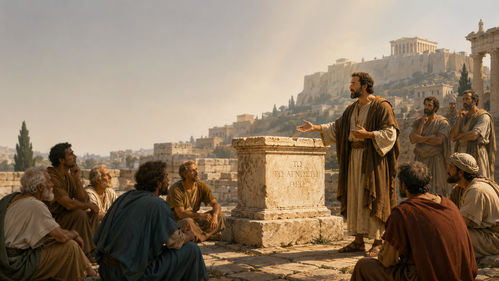
Athens was filled with impressive things. Temples. Statues. Altars. Schools of thought. Public debate. New ideas. It was one of the great intellectual and cultural centers of the ancient world. Yet when Paul looked around the city, he was not primarily impressed. He was distressed because the city was full of idols.
The people of Athens were deeply religious, but their devotion was scattered in every direction. They had constructed images, developed philosophies, and built shrines in an effort to understand the divine. They even had an altar dedicated “To an unknown God,” perhaps to make sure they had not overlooked someone. That altar gave Paul a place to begin.
He did not walk into Athens insulting everyone or dismissing their questions. He paid attention. He listened. He understood enough of their culture to speak within it. He referred to their altar and even quoted their poets. But Paul did not reshape the gospel to make it comfortably fit what the Athenians already believed. He began where they were, and then he challenged them to see everything differently.
The true God is not one god among many. God is the Creator of the world and everything in it. God cannot be contained in temples, represented by statues, or sustained by human offerings.
God is the One who gives life, breath, and everything else. The Athenians believed they were searching for the divine. Paul tells them that the God they seek is already near.
“God isn’t far away from any of us,” he says. “In God we live, move, and exist” (Acts 17:27–28). That is a remarkable picture of grace. Before the people of Athens understood God, God was already sustaining them. Before they knew the truth, God was already near. Before they began searching, God’s grace was already at work. This is prevenient grace: the grace that comes before our full awareness, awakening desire, stirring questions, and drawing people toward God.
Our culture is also filled with idols and ideas. Most of them are not carved from gold, silver, or stone. They are harder to recognize because they often appear ordinary, respectable, or even necessary.
We place our trust in success, political power, financial security, personal freedom, technology, influence, or the approval of others. We may not kneel before statues, but we still build our lives around things that promise meaning, identity, safety, or control. Like the Athenians, we can be deeply devoted and still devoted to the wrong things.
Paul doesn't say that every human desire or idea is entirely false. He recognizes that the Athenians are reaching for something real. Their poets have caught glimpses of truth. Their altar reveals an awareness that their knowledge is incomplete. But a glimpse is not the same as the gospel.
Paul doesn't leave God unnamed. The unknown God has made God’s self known in Jesus Christ. God has acted decisively in history. The time for wandering in ignorance has come to an end. Jesus has been raised from the dead, and his resurrection declares that God’s work of setting the world right has already begun. This is where Paul’s message becomes difficult for his listeners.
The Athenians were willing to discuss religion. They enjoyed hearing new ideas. But resurrection was not simply another concept to debate. It challenged the foundations of their worldview. The resurrection still does that. Christian faith is not one spiritual option among many, added to the collection of ideas we already find useful. Jesus doesn't come just to improve our philosophy of life. The risen Christ confronts every idol, every false loyalty, and every assumption that competes with the truth of God.
Because Jesus is risen, repentance is possible and necessary. Repentance means more than admitting that we were mistaken. It means turning away from the gods we have created and turning toward the living God who created us.
Some mocked Paul. Others wanted to hear more. A few believed. Those responses still exist.
Some dismiss the resurrection immediately. Some remain curious but keep Christ at a safe distance. Others recognize that God is near, grace is calling, and life can no longer remain unchanged.
Our calling as the church is similar to Paul’s. We should learn to listen carefully to the people and culture around us. We should understand the questions our neighbors are asking, the hopes they carry, and the things in which they have placed their trust. We should look for the places where grace is already creating an opening... But we must also speak clearly.
We can't reduce Jesus to something that just confirms what everyone already believes. Faithful witness begins with compassion and understanding, but it leads toward the risen Christ. The God whom people are reaching for is not far away. God wants to be known. In Jesus, God has drawn near enough to call every one of us to turn, trust, and live.
The people of Athens were deeply religious, but their devotion was scattered in every direction. They had constructed images, developed philosophies, and built shrines in an effort to understand the divine. They even had an altar dedicated “To an unknown God,” perhaps to make sure they had not overlooked someone. That altar gave Paul a place to begin.
He did not walk into Athens insulting everyone or dismissing their questions. He paid attention. He listened. He understood enough of their culture to speak within it. He referred to their altar and even quoted their poets. But Paul did not reshape the gospel to make it comfortably fit what the Athenians already believed. He began where they were, and then he challenged them to see everything differently.
The true God is not one god among many. God is the Creator of the world and everything in it. God cannot be contained in temples, represented by statues, or sustained by human offerings.
God is the One who gives life, breath, and everything else. The Athenians believed they were searching for the divine. Paul tells them that the God they seek is already near.
“God isn’t far away from any of us,” he says. “In God we live, move, and exist” (Acts 17:27–28). That is a remarkable picture of grace. Before the people of Athens understood God, God was already sustaining them. Before they knew the truth, God was already near. Before they began searching, God’s grace was already at work. This is prevenient grace: the grace that comes before our full awareness, awakening desire, stirring questions, and drawing people toward God.
Our culture is also filled with idols and ideas. Most of them are not carved from gold, silver, or stone. They are harder to recognize because they often appear ordinary, respectable, or even necessary.
We place our trust in success, political power, financial security, personal freedom, technology, influence, or the approval of others. We may not kneel before statues, but we still build our lives around things that promise meaning, identity, safety, or control. Like the Athenians, we can be deeply devoted and still devoted to the wrong things.
Paul doesn't say that every human desire or idea is entirely false. He recognizes that the Athenians are reaching for something real. Their poets have caught glimpses of truth. Their altar reveals an awareness that their knowledge is incomplete. But a glimpse is not the same as the gospel.
Paul doesn't leave God unnamed. The unknown God has made God’s self known in Jesus Christ. God has acted decisively in history. The time for wandering in ignorance has come to an end. Jesus has been raised from the dead, and his resurrection declares that God’s work of setting the world right has already begun. This is where Paul’s message becomes difficult for his listeners.
The Athenians were willing to discuss religion. They enjoyed hearing new ideas. But resurrection was not simply another concept to debate. It challenged the foundations of their worldview. The resurrection still does that. Christian faith is not one spiritual option among many, added to the collection of ideas we already find useful. Jesus doesn't come just to improve our philosophy of life. The risen Christ confronts every idol, every false loyalty, and every assumption that competes with the truth of God.
Because Jesus is risen, repentance is possible and necessary. Repentance means more than admitting that we were mistaken. It means turning away from the gods we have created and turning toward the living God who created us.
Some mocked Paul. Others wanted to hear more. A few believed. Those responses still exist.
Some dismiss the resurrection immediately. Some remain curious but keep Christ at a safe distance. Others recognize that God is near, grace is calling, and life can no longer remain unchanged.
Our calling as the church is similar to Paul’s. We should learn to listen carefully to the people and culture around us. We should understand the questions our neighbors are asking, the hopes they carry, and the things in which they have placed their trust. We should look for the places where grace is already creating an opening... But we must also speak clearly.
We can't reduce Jesus to something that just confirms what everyone already believes. Faithful witness begins with compassion and understanding, but it leads toward the risen Christ. The God whom people are reaching for is not far away. God wants to be known. In Jesus, God has drawn near enough to call every one of us to turn, trust, and live.
Faith In Action
Identify one belief, loyalty, or habit that may be occupying a place in your life that belongs to God. Name it honestly in prayer, and ask the Holy Spirit to help you turn toward Christ with renewed trust.
Today's Prayer
Creator God, you give us life, breath, and every good gift. Forgive us for placing our trust in things we have created, controlled, or imagined. Open our eyes to the idols that compete for our loyalty. Thank you for drawing near to us before we understood what we were seeking. Through the risen Christ, lead us out of ignorance and into truth. Give us wisdom to listen well, courage to speak clearly, and grace to point others toward you without pride or fear. Shape our lives so that our witness reveals not an unknown God, but the God who has made your love known in Jesus. Amen.
Posted in Bible Reading Plan 2026
Recent
2026 Reading Plan Reflections - Day 274
October 1st, 2026
2026 Reading Plan Reflections - Day 273
September 30th, 2026
2026 Reading Plan Reflections - Day 272
September 29th, 2026
2026 Reading Plan Reflections - Day 271
September 28th, 2026
2026 Reading Plan Reflections - Day 270
September 27th, 2026
Categories
Archive
2026
January
My Word for the Year... LIGHT2026 Reading Plan Reflections - Day 12026 Reading Plan Reflections - Day 22026 Reading Plan Reflections - Day 32026 Reading Plan Reflections - Day 42026 Reading Plan Reflections - Day 5Welcome to 2026 - New Resources2026 Reading Plan Reflections - Day 62026 Reading Plan Reflections - Day 72026 Reading Plan Reflections - Day 8New Year Prayer Focus2026 Reading Plan Reflections - Day 92026 Reading Plan Reflections - Day 102026 Reading Plan Reflections - Day 112026 Reading Plan Reflections - Day 122026 Reading Plan Reflections - Day 132026 Reading Plan Reflections - Day 142026 Reading Plan Reflections - Day 152026 Reading Plan Reflections - Day 16Darkness and Light2026 Reading Plan Reflections - Day 172026 Reading Plan Reflections - Day 182026 Reading Plan Reflections - Day 192026 Reading Plan Reflections - Day 202026 Reading Plan Reflections - Day 212026 Reading Plan Reflections - Day 222026 Reading Plan Reflections - Day 232026 Reading Plan Reflections - Day 242026 Reading Plan Reflections - Day 252026 Reading Plan Reflections - Day 262026 Reading Plan Reflections - Day 272026 Reading Plan Reflections - Day 282026 Reading Plan Reflections - Day 292026 Reading Plan Reflections - Day 30Together as the Body of Christ2026 Reading Plan Reflections - Day 31
February
2026 Reading Plan Reflections - Day 322026 Reading Plan Reflections - Day 332026 Reading Plan Reflections - Day 342026 Reading Plan Reflections - Day 352026 Reading Plan Reflections - Day 362026 Reading Plan Reflections - Day 37This Shouldn’t Need to Be Said...2026 Reading Plan Reflections - Day 382026 Reading Plan Reflections - Day 392026 Reading Plan Reflections - Day 402026 Reading Plan Reflections - Day 412026 Reading Plan Reflections - Day 422026 Reading Plan Reflections - Day 432026 Reading Plan Reflections - Day 442026 Reading Plan Reflections - Day 452026 Reading Plan Reflections - Day 462026 Reading Plan Reflections - Day 472026 Reading Plan Reflections - Day 482026 Reading Plan Reflections - Day 492026 Reading Plan Reflections - Day 502026 Reading Plan Reflections - Day 512026 Reading Plan Reflections - Day 522026 Reading Plan Reflections - Day 532026 Reading Plan Reflections - Day 542026 Reading Plan Reflections - Day 552026 Reading Plan Reflections - Day 562026 Reading Plan Reflections - Day 572026 Reading Plan Reflections - Day 582026 Reading Plan Reflections - Day 59
March
2026 Reading Plan Reflections - Day 602026 Reading Plan Reflections - Day 612026 Reading Plan Reflections - Day 622026 Reading Plan Reflections - Day 632026 Reading Plan Reflections - Day 642026 Reading Plan Reflections - Day 652026 Reading Plan Reflections - Day 662026 Reading Plan Reflections - Day 672026 Reading Plan Reflections - Day 682026 Reading Plan Reflections - Day 692026 Reading Plan Reflections - Day 702026 Reading Plan Reflections - Day 712026 Reading Plan Reflections - Day 722026 Reading Plan Reflections - Day 732026 Reading Plan Reflections - Day 742026 Reading Plan Reflections - Day 752026 Reading Plan Reflections - Day 762026 Reading Plan Reflections - Day 772026 Reading Plan Reflections - Day 782026 Reading Plan Reflections - Day 792026 Reading Plan Reflections - Day 802026 Reading Plan Reflections - Day 812026 Reading Plan Reflections - Day 822026 Reading Plan Reflections - Day 832026 Reading Plan Reflections - Day 84
April
2026 Reading Plan Reflections - Days 85 & 862026 Reading Plan Reflections - Day 872026 Reading Plan Reflections - Day 882026 Reading Plan Reflections - Day 892026 Reading Plan Reflections - Day 902026 Reading Plan Reflections - Day 912026 Reading Plan Reflections - Day 922026 Reading Plan Reflections - Day 932026 Reading Plan Reflections - Day 942026 Reading Plan Reflections - Day 95
No Comments