
2026 Reading Plan Reflections - Day 184
The Word Still Grows
Acts 12:1–25
“But God’s word continued to grow and increase.” Acts 12:24 CEB
Acts 12 begins with a sword and ends with the Word of God. Between those two images, Luke brings the first major movement of Acts to a close. The gospel has been proclaimed in Jerusalem, throughout Judea and Samaria, and now among the Gentiles. Opposition has come from religious leaders, angry crowds, and governing authorities. Yet none of them has been able to stop what the risen Jesus is doing.
Herod believes he can. He has James, the brother of John, killed with the sword. When he sees that James’s death wins public approval, he arrests Peter and plans to make a spectacle of him after Passover. Herod’s concern isn’t justice. He is protecting his power and strengthening his position by giving the crowd what it wants.
The conflict beneath the surface is about more than politics. The church is proclaiming Jesus as the Messiah—the true King. Herod bears a royal title granted by Rome, but Jesus reigns by the authority of God. Herod can imprison Christ’s witnesses, but he cannot imprison the gospel.
Still, Luke doesn’t allow us to reduce this story to a simple formula in which faithful people always escape suffering. James is killed. Peter is delivered.
The church prayed for Peter, but we have every reason to believe they also prayed for James. One apostle died while another walked free. Scripture doesn’t explain why God permitted one outcome and intervened dramatically in the other. Faith does not require us to pretend that this tension is easy.
God’s providence remains trustworthy, but it is often mysterious. We may pray faithfully and still grieve deeply. Deliverance does not always come in the form we seek. Yet neither suffering nor death means that Christ has lost control of his kingdom.
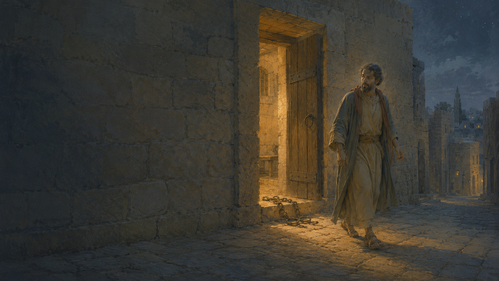
While Peter sleeps between two soldiers, chained and guarded, an angel awakens him. His chains fall away. The prison doors open. Peter walks into the street before he fully realizes what has happened. Meanwhile, the church is gathered in prayer.
When Peter arrives at the house and knocks, a servant named Rhoda recognizes his voice. She becomes so excited that she runs inside without opening the door. The people who have been praying for Peter refuse to believe her when she says he is standing outside.
There is something wonderfully honest about this scene. These believers have enough faith to pray through the night, yet they struggle to recognize the answer when it begins knocking at the door.
They are not flawless heroes. They are ordinary disciples—praying, hoping, doubting, and trying to understand what God is doing. That should encourage us. Effective prayer doesn't depend on perfect confidence or emotional certainty. God’s grace is greater than the weakness and confusion we bring into the room. We can pray honestly, even when part of us wonders whether anything will change.
Peter eventually enters, tells them how the Lord brought him out of prison, and instructs them to tell James and the other believers. This James is the brother of Jesus, who is now emerging as a central leader in the Jerusalem church. Peter then leaves for another place.
A transition is underway. James the son of Zebedee has died. Peter steps away from public leadership in Jerusalem. James the brother of Jesus takes greater responsibility. Soon Barnabas and Saul will carry the gospel farther into the Gentile world. The leaders may change, but the mission continues.
The chapter ends by returning to Herod. Dressed in royal robes, he receives the praise of the people when they declare that his voice is the voice of a god rather than a human being. Herod accepts glory that belongs to God, and his life comes to a humiliating end.
Then Luke gives us one quiet sentence that interprets the entire chapter: “But God’s word continued to grow and increase” (Acts 12:24 CEB).
James has been killed. Peter has been imprisoned and released. Herod has risen in pride and fallen under judgment. Leadership is changing. The church is moving into unfamiliar territory.
But the Word still grows.
Human power is temporary. Public approval shifts. Leaders come and go. Some doors close while others open. Yet the gospel does not depend upon one ruler’s permission, one apostle’s presence, or the church’s perfect faith. It advances because Jesus is alive and reigning.
Our calling is not to control the outcome. We are called to remain faithful: praying when we are afraid, witnessing when obedience is costly, trusting when God’s ways are difficult to understand, and making room for new leaders when the mission moves forward.
The true King is still at work. His Word has not been chained. And the church’s future rests securely in his hands.
Herod believes he can. He has James, the brother of John, killed with the sword. When he sees that James’s death wins public approval, he arrests Peter and plans to make a spectacle of him after Passover. Herod’s concern isn’t justice. He is protecting his power and strengthening his position by giving the crowd what it wants.
The conflict beneath the surface is about more than politics. The church is proclaiming Jesus as the Messiah—the true King. Herod bears a royal title granted by Rome, but Jesus reigns by the authority of God. Herod can imprison Christ’s witnesses, but he cannot imprison the gospel.
Still, Luke doesn’t allow us to reduce this story to a simple formula in which faithful people always escape suffering. James is killed. Peter is delivered.
The church prayed for Peter, but we have every reason to believe they also prayed for James. One apostle died while another walked free. Scripture doesn’t explain why God permitted one outcome and intervened dramatically in the other. Faith does not require us to pretend that this tension is easy.
God’s providence remains trustworthy, but it is often mysterious. We may pray faithfully and still grieve deeply. Deliverance does not always come in the form we seek. Yet neither suffering nor death means that Christ has lost control of his kingdom.
While Peter sleeps between two soldiers, chained and guarded, an angel awakens him. His chains fall away. The prison doors open. Peter walks into the street before he fully realizes what has happened. Meanwhile, the church is gathered in prayer.
When Peter arrives at the house and knocks, a servant named Rhoda recognizes his voice. She becomes so excited that she runs inside without opening the door. The people who have been praying for Peter refuse to believe her when she says he is standing outside.
There is something wonderfully honest about this scene. These believers have enough faith to pray through the night, yet they struggle to recognize the answer when it begins knocking at the door.
They are not flawless heroes. They are ordinary disciples—praying, hoping, doubting, and trying to understand what God is doing. That should encourage us. Effective prayer doesn't depend on perfect confidence or emotional certainty. God’s grace is greater than the weakness and confusion we bring into the room. We can pray honestly, even when part of us wonders whether anything will change.
Peter eventually enters, tells them how the Lord brought him out of prison, and instructs them to tell James and the other believers. This James is the brother of Jesus, who is now emerging as a central leader in the Jerusalem church. Peter then leaves for another place.
A transition is underway. James the son of Zebedee has died. Peter steps away from public leadership in Jerusalem. James the brother of Jesus takes greater responsibility. Soon Barnabas and Saul will carry the gospel farther into the Gentile world. The leaders may change, but the mission continues.
The chapter ends by returning to Herod. Dressed in royal robes, he receives the praise of the people when they declare that his voice is the voice of a god rather than a human being. Herod accepts glory that belongs to God, and his life comes to a humiliating end.
Then Luke gives us one quiet sentence that interprets the entire chapter: “But God’s word continued to grow and increase” (Acts 12:24 CEB).
James has been killed. Peter has been imprisoned and released. Herod has risen in pride and fallen under judgment. Leadership is changing. The church is moving into unfamiliar territory.
But the Word still grows.
Human power is temporary. Public approval shifts. Leaders come and go. Some doors close while others open. Yet the gospel does not depend upon one ruler’s permission, one apostle’s presence, or the church’s perfect faith. It advances because Jesus is alive and reigning.
Our calling is not to control the outcome. We are called to remain faithful: praying when we are afraid, witnessing when obedience is costly, trusting when God’s ways are difficult to understand, and making room for new leaders when the mission moves forward.
The true King is still at work. His Word has not been chained. And the church’s future rests securely in his hands.
Faith In Action
Pray today for one situation that appears closed, threatened, or beyond your control. Name your fear honestly, ask God to act, and then remain attentive to any door God may already be opening.
Today's Prayer
King Jesus, you remain faithful when the world feels uncertain and when your ways are difficult for us to understand. Teach us to pray honestly, trust you through both deliverance and grief, and recognize your grace when it comes knocking at the door. Guard us from seeking power, praise, or control that belongs to you alone. Give your church courage to remain faithful as leaders change and the mission moves forward. Let your Word continue to grow through our witness, our prayers, and our obedience. Amen.
Posted in Bible Reading Plan 2026
Recent
2026 Reading Plan Reflections - Day 264
September 21st, 2026
2026 Reading Plan Reflections - Day 262-263
September 19th, 2026
2026 Reading Plan Reflections - Day 261
September 18th, 2026
2026 Reading Plan Reflections - Day 260
September 17th, 2026
2026 Reading Plan Reflections - Day 259
September 16th, 2026
Categories
Archive
2026
January
My Word for the Year... LIGHT2026 Reading Plan Reflections - Day 12026 Reading Plan Reflections - Day 22026 Reading Plan Reflections - Day 32026 Reading Plan Reflections - Day 42026 Reading Plan Reflections - Day 5Welcome to 2026 - New Resources2026 Reading Plan Reflections - Day 62026 Reading Plan Reflections - Day 72026 Reading Plan Reflections - Day 8New Year Prayer Focus2026 Reading Plan Reflections - Day 92026 Reading Plan Reflections - Day 102026 Reading Plan Reflections - Day 112026 Reading Plan Reflections - Day 122026 Reading Plan Reflections - Day 132026 Reading Plan Reflections - Day 142026 Reading Plan Reflections - Day 152026 Reading Plan Reflections - Day 16Darkness and Light2026 Reading Plan Reflections - Day 172026 Reading Plan Reflections - Day 182026 Reading Plan Reflections - Day 192026 Reading Plan Reflections - Day 202026 Reading Plan Reflections - Day 212026 Reading Plan Reflections - Day 222026 Reading Plan Reflections - Day 232026 Reading Plan Reflections - Day 242026 Reading Plan Reflections - Day 252026 Reading Plan Reflections - Day 262026 Reading Plan Reflections - Day 272026 Reading Plan Reflections - Day 282026 Reading Plan Reflections - Day 292026 Reading Plan Reflections - Day 30Together as the Body of Christ2026 Reading Plan Reflections - Day 31
February
2026 Reading Plan Reflections - Day 322026 Reading Plan Reflections - Day 332026 Reading Plan Reflections - Day 342026 Reading Plan Reflections - Day 352026 Reading Plan Reflections - Day 362026 Reading Plan Reflections - Day 37This Shouldn’t Need to Be Said...2026 Reading Plan Reflections - Day 382026 Reading Plan Reflections - Day 392026 Reading Plan Reflections - Day 402026 Reading Plan Reflections - Day 412026 Reading Plan Reflections - Day 422026 Reading Plan Reflections - Day 432026 Reading Plan Reflections - Day 442026 Reading Plan Reflections - Day 452026 Reading Plan Reflections - Day 462026 Reading Plan Reflections - Day 472026 Reading Plan Reflections - Day 482026 Reading Plan Reflections - Day 492026 Reading Plan Reflections - Day 502026 Reading Plan Reflections - Day 512026 Reading Plan Reflections - Day 522026 Reading Plan Reflections - Day 532026 Reading Plan Reflections - Day 542026 Reading Plan Reflections - Day 552026 Reading Plan Reflections - Day 562026 Reading Plan Reflections - Day 572026 Reading Plan Reflections - Day 582026 Reading Plan Reflections - Day 59
March
2026 Reading Plan Reflections - Day 602026 Reading Plan Reflections - Day 612026 Reading Plan Reflections - Day 622026 Reading Plan Reflections - Day 632026 Reading Plan Reflections - Day 642026 Reading Plan Reflections - Day 652026 Reading Plan Reflections - Day 662026 Reading Plan Reflections - Day 672026 Reading Plan Reflections - Day 682026 Reading Plan Reflections - Day 692026 Reading Plan Reflections - Day 702026 Reading Plan Reflections - Day 712026 Reading Plan Reflections - Day 722026 Reading Plan Reflections - Day 732026 Reading Plan Reflections - Day 742026 Reading Plan Reflections - Day 752026 Reading Plan Reflections - Day 762026 Reading Plan Reflections - Day 772026 Reading Plan Reflections - Day 782026 Reading Plan Reflections - Day 792026 Reading Plan Reflections - Day 802026 Reading Plan Reflections - Day 812026 Reading Plan Reflections - Day 822026 Reading Plan Reflections - Day 832026 Reading Plan Reflections - Day 84
April
2026 Reading Plan Reflections - Days 85 & 862026 Reading Plan Reflections - Day 872026 Reading Plan Reflections - Day 882026 Reading Plan Reflections - Day 892026 Reading Plan Reflections - Day 902026 Reading Plan Reflections - Day 912026 Reading Plan Reflections - Day 922026 Reading Plan Reflections - Day 932026 Reading Plan Reflections - Day 942026 Reading Plan Reflections - Day 95
No Comments