
2026 Reading Plan Reflections - Day 202
The Lord Stood Near
Acts 23:1—11
“Brothers, I have lived my life with an entirely clear conscience before God up to this very day.” Acts 23:1 CEB
Paul begins his defense before the council: “Brothers, I have lived my life with an entirely clear conscience before God up to this very day” (Acts 23:1 CEB).
That doesn't mean Paul believed he had never sinned, failed, or acted wrongly. His own letters make clear that he knew the depth of his need for grace. A clear conscience is not the same as a flawless record. It is the settled confidence that we are walking honestly before God, responding to conviction, and making things right when we recognize that we have done wrong. Paul demonstrates that almost immediately.
When the high priest Ananias orders him to be struck, Paul forcefully condemns the injustice. The council is supposed to judge according to the law, yet Paul is being punished before any judgment has been made. His accusation is justified. The institution charged with administering justice is violating its own standard.
But when Paul learns that the man he addressed is the high priest, he acknowledges that Scripture forbids speaking evil of a ruler. Paul does not withdraw his criticism of the injustice. He does, however, accept responsibility for how he spoke.
That combination is difficult for us to hold together. We tend to believe that respecting authority means remaining silent when authority is abused. Others assume that confronting wrongdoing gives us permission to say whatever we want in whatever manner we choose. Paul does neither. He honors the office while still naming the injustice. Then, when he realizes that his own words crossed a boundary, he corrects himself.
A clear conscience doesn't require pretending we were right about everything. Sometimes the most faithful thing we can do is say, “What happened was wrong, but I was also wrong in the way I responded.” Grace teaches us to tell the truth without surrendering humility.
Paul then recognizes that the council is divided between Sadducees and Pharisees. The Sadducees reject the resurrection, while the Pharisees affirm that God will raise the dead and set creation right. Paul declares that he is on trial because of the hope of the resurrection. This is more than a clever courtroom strategy. The resurrection really is the heart of the matter.
Paul’s entire life has been reordered by the risen Christ. He's not standing before the council because he has introduced a slightly different religious opinion. He's there because he has testified that Jesus, who was crucified, is alive—and that through Jesus, God’s promised renewal has already begun. The resurrection announces that human judgment is not final.
Violence is not final. Corrupt institutions are not final. Death itself is not final. God will set creation right, and the resurrection of Jesus is the beginning of that new creation.
The council erupts into such disorder that the Roman commander fears Paul will be torn apart. Paul is pulled away by force and returned to the barracks. His attempt to bear witness appears to have ended in confusion. The religious leaders are divided. The authorities do not understand him. The crowd is hostile. Paul is confined and facing an uncertain future.
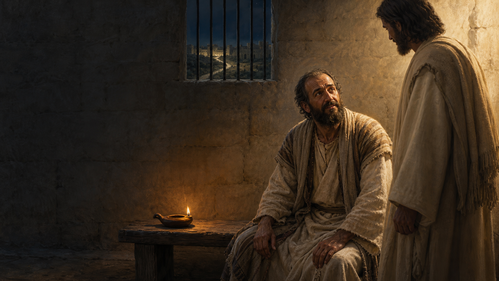
Then Luke tells us, “The following night the Lord stood near Paul.” Christ doesn't send Paul a message from a distance. The Lord stands near. In the middle of confinement, uncertainty, and opposition, Paul isn't abandoned. Jesus tells him to be encouraged because his witness in Jerusalem is not the end of his calling. Paul will also testify in Rome.
Paul isn't promised an easier road. He's given the assurance of Christ’s presence and the confirmation of Christ’s purpose.
We often want God to remove the difficulty. Sometimes God does. But in this passage, Jesus gives Paul something deeper than an immediate escape: “I am near, and your witness is not finished.”
There may be seasons when our faithfulness feels ineffective. We try to speak truth, but the conversation falls apart. We try to do what is right, but our motives are misunderstood. We may even recognize places where our own response was imperfect and needs correction. None of that means God has abandoned the work.
Grace allows us to repent where we were wrong, remain firm where truth is at stake, and continue bearing witness without being consumed by fear or bitterness. Our confidence is not found in having handled every moment perfectly. It is found in the risen Christ who stands near, corrects us, strengthens us, and continues to lead us.
Paul’s circumstances were unstable, but his calling remained secure because Christ was present. The same is true for us, by God's grace.
That doesn't mean Paul believed he had never sinned, failed, or acted wrongly. His own letters make clear that he knew the depth of his need for grace. A clear conscience is not the same as a flawless record. It is the settled confidence that we are walking honestly before God, responding to conviction, and making things right when we recognize that we have done wrong. Paul demonstrates that almost immediately.
When the high priest Ananias orders him to be struck, Paul forcefully condemns the injustice. The council is supposed to judge according to the law, yet Paul is being punished before any judgment has been made. His accusation is justified. The institution charged with administering justice is violating its own standard.
But when Paul learns that the man he addressed is the high priest, he acknowledges that Scripture forbids speaking evil of a ruler. Paul does not withdraw his criticism of the injustice. He does, however, accept responsibility for how he spoke.
That combination is difficult for us to hold together. We tend to believe that respecting authority means remaining silent when authority is abused. Others assume that confronting wrongdoing gives us permission to say whatever we want in whatever manner we choose. Paul does neither. He honors the office while still naming the injustice. Then, when he realizes that his own words crossed a boundary, he corrects himself.
A clear conscience doesn't require pretending we were right about everything. Sometimes the most faithful thing we can do is say, “What happened was wrong, but I was also wrong in the way I responded.” Grace teaches us to tell the truth without surrendering humility.
Paul then recognizes that the council is divided between Sadducees and Pharisees. The Sadducees reject the resurrection, while the Pharisees affirm that God will raise the dead and set creation right. Paul declares that he is on trial because of the hope of the resurrection. This is more than a clever courtroom strategy. The resurrection really is the heart of the matter.
Paul’s entire life has been reordered by the risen Christ. He's not standing before the council because he has introduced a slightly different religious opinion. He's there because he has testified that Jesus, who was crucified, is alive—and that through Jesus, God’s promised renewal has already begun. The resurrection announces that human judgment is not final.
Violence is not final. Corrupt institutions are not final. Death itself is not final. God will set creation right, and the resurrection of Jesus is the beginning of that new creation.
The council erupts into such disorder that the Roman commander fears Paul will be torn apart. Paul is pulled away by force and returned to the barracks. His attempt to bear witness appears to have ended in confusion. The religious leaders are divided. The authorities do not understand him. The crowd is hostile. Paul is confined and facing an uncertain future.
Then Luke tells us, “The following night the Lord stood near Paul.” Christ doesn't send Paul a message from a distance. The Lord stands near. In the middle of confinement, uncertainty, and opposition, Paul isn't abandoned. Jesus tells him to be encouraged because his witness in Jerusalem is not the end of his calling. Paul will also testify in Rome.
Paul isn't promised an easier road. He's given the assurance of Christ’s presence and the confirmation of Christ’s purpose.
We often want God to remove the difficulty. Sometimes God does. But in this passage, Jesus gives Paul something deeper than an immediate escape: “I am near, and your witness is not finished.”
There may be seasons when our faithfulness feels ineffective. We try to speak truth, but the conversation falls apart. We try to do what is right, but our motives are misunderstood. We may even recognize places where our own response was imperfect and needs correction. None of that means God has abandoned the work.
Grace allows us to repent where we were wrong, remain firm where truth is at stake, and continue bearing witness without being consumed by fear or bitterness. Our confidence is not found in having handled every moment perfectly. It is found in the risen Christ who stands near, corrects us, strengthens us, and continues to lead us.
Paul’s circumstances were unstable, but his calling remained secure because Christ was present. The same is true for us, by God's grace.
Faith In Action
Think of one recent conflict or difficult conversation. Ask God to show you both where truth needs to be spoken and where humility or apology may be needed. Take one faithful step toward making it right today.
Today's Prayer
Risen Christ, thank you for standing near when we feel misunderstood, discouraged, or uncertain. Give us courage to speak truth without becoming proud or harsh. Give us humility to recognize when our own words or actions need correction.
Cleanse our consciences, form us in your likeness, and keep us faithful to the witness you have entrusted to us. When our efforts seem to end in confusion, remind us that your purpose is not finished and your presence has not left us.
Help us trust you enough to repent, endure, and continue wherever you lead. Amen.
Cleanse our consciences, form us in your likeness, and keep us faithful to the witness you have entrusted to us. When our efforts seem to end in confusion, remind us that your purpose is not finished and your presence has not left us.
Help us trust you enough to repent, endure, and continue wherever you lead. Amen.
Posted in Bible Reading Plan 2026
Recent
Categories
Archive
2026
January
My Word for the Year... LIGHT2026 Reading Plan Reflections - Day 12026 Reading Plan Reflections - Day 22026 Reading Plan Reflections - Day 32026 Reading Plan Reflections - Day 42026 Reading Plan Reflections - Day 5Welcome to 2026 - New Resources2026 Reading Plan Reflections - Day 62026 Reading Plan Reflections - Day 72026 Reading Plan Reflections - Day 8New Year Prayer Focus2026 Reading Plan Reflections - Day 92026 Reading Plan Reflections - Day 102026 Reading Plan Reflections - Day 112026 Reading Plan Reflections - Day 122026 Reading Plan Reflections - Day 132026 Reading Plan Reflections - Day 142026 Reading Plan Reflections - Day 152026 Reading Plan Reflections - Day 16Darkness and Light2026 Reading Plan Reflections - Day 172026 Reading Plan Reflections - Day 182026 Reading Plan Reflections - Day 192026 Reading Plan Reflections - Day 202026 Reading Plan Reflections - Day 212026 Reading Plan Reflections - Day 222026 Reading Plan Reflections - Day 232026 Reading Plan Reflections - Day 242026 Reading Plan Reflections - Day 252026 Reading Plan Reflections - Day 262026 Reading Plan Reflections - Day 272026 Reading Plan Reflections - Day 282026 Reading Plan Reflections - Day 292026 Reading Plan Reflections - Day 30Together as the Body of Christ2026 Reading Plan Reflections - Day 31
February
2026 Reading Plan Reflections - Day 322026 Reading Plan Reflections - Day 332026 Reading Plan Reflections - Day 342026 Reading Plan Reflections - Day 352026 Reading Plan Reflections - Day 362026 Reading Plan Reflections - Day 37This Shouldn’t Need to Be Said...2026 Reading Plan Reflections - Day 382026 Reading Plan Reflections - Day 392026 Reading Plan Reflections - Day 402026 Reading Plan Reflections - Day 412026 Reading Plan Reflections - Day 422026 Reading Plan Reflections - Day 432026 Reading Plan Reflections - Day 442026 Reading Plan Reflections - Day 452026 Reading Plan Reflections - Day 462026 Reading Plan Reflections - Day 472026 Reading Plan Reflections - Day 482026 Reading Plan Reflections - Day 492026 Reading Plan Reflections - Day 502026 Reading Plan Reflections - Day 512026 Reading Plan Reflections - Day 522026 Reading Plan Reflections - Day 532026 Reading Plan Reflections - Day 542026 Reading Plan Reflections - Day 552026 Reading Plan Reflections - Day 562026 Reading Plan Reflections - Day 572026 Reading Plan Reflections - Day 582026 Reading Plan Reflections - Day 59
March
2026 Reading Plan Reflections - Day 602026 Reading Plan Reflections - Day 612026 Reading Plan Reflections - Day 622026 Reading Plan Reflections - Day 632026 Reading Plan Reflections - Day 642026 Reading Plan Reflections - Day 652026 Reading Plan Reflections - Day 662026 Reading Plan Reflections - Day 672026 Reading Plan Reflections - Day 682026 Reading Plan Reflections - Day 692026 Reading Plan Reflections - Day 702026 Reading Plan Reflections - Day 712026 Reading Plan Reflections - Day 722026 Reading Plan Reflections - Day 732026 Reading Plan Reflections - Day 742026 Reading Plan Reflections - Day 752026 Reading Plan Reflections - Day 762026 Reading Plan Reflections - Day 772026 Reading Plan Reflections - Day 782026 Reading Plan Reflections - Day 792026 Reading Plan Reflections - Day 802026 Reading Plan Reflections - Day 812026 Reading Plan Reflections - Day 822026 Reading Plan Reflections - Day 832026 Reading Plan Reflections - Day 84
April
2026 Reading Plan Reflections - Days 85 & 862026 Reading Plan Reflections - Day 872026 Reading Plan Reflections - Day 882026 Reading Plan Reflections - Day 892026 Reading Plan Reflections - Day 902026 Reading Plan Reflections - Day 912026 Reading Plan Reflections - Day 922026 Reading Plan Reflections - Day 932026 Reading Plan Reflections - Day 942026 Reading Plan Reflections - Day 95
No Comments